
Healthcare organizations worldwide are under pressure to do more with less. Patient volumes are increasing, costs are rising, regulatory requirements are tightening, and expectations around care quality continue to grow. In this environment, AI in medicine and healthcare is no longer a future concept. It is a practical tool that helps healthcare systems scale operations, improve efficiency, and support better clinical decisions.
However, implementing AI is not just about adding a chatbot or deploying a predictive model. For hospitals, clinics, and digital health companies, success depends on building systems that are scalable, secure, and aligned with real healthcare workflows. This guide breaks down the AI implementation journey in healthcare step by step, with a focus on long-term scalability and innovation.
Healthcare data grows rapidly. Patient records, imaging files, wearable data, and clinical notes increase every day. AI systems must handle this growth without compromising performance or security.
Scalable AI systems allow healthcare organizations to:
Without scalability, AI solutions become bottlenecks instead of enablers. That is why scalability must be planned from day one of the AI development process.
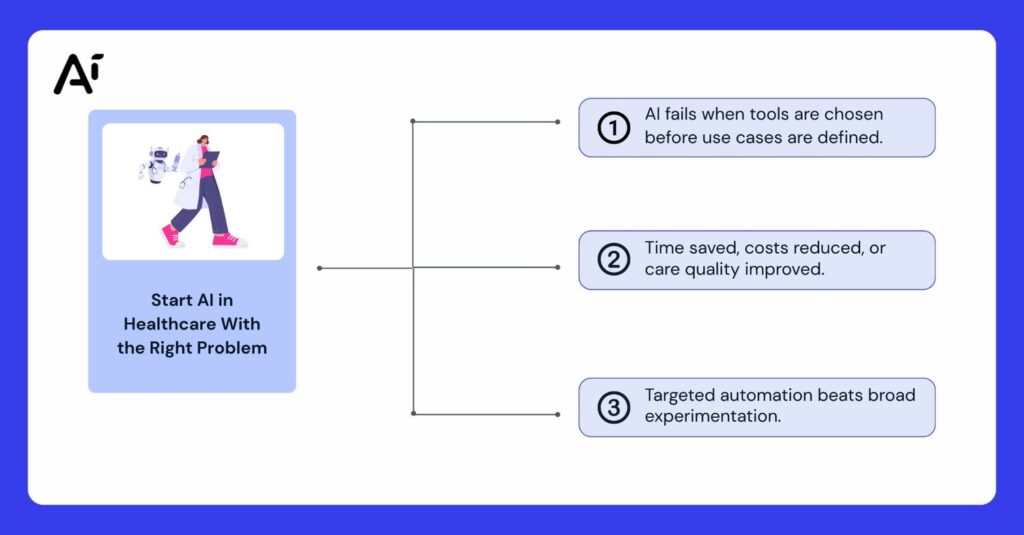
The first step in implementing AI solutions is clarity. Many healthcare organizations fail because they start with technology instead of problems.
Begin by identifying areas where AI can deliver measurable value, such as:
For example, healthcare automation tools can reduce appointment scheduling delays, automate insurance claims processing, or assist clinicians with medical record documentation. Each use case should clearly define the expected outcome, whether it is cost reduction, time savings, or improved patient care.
AI systems depend on high-quality data. In healthcare, this includes structured data, such as lab results, and unstructured data, such as clinical notes and imaging files.
Before moving forward, organizations should evaluate:
Many healthcare providers struggle with fragmented data across multiple systems. A strong data foundation ensures that AI models can learn effectively and scale as data volumes increase.
Security is critical when implementing AI in medicine and healthcare. Patient data is highly sensitive, and breaches can lead to legal and reputational damage.
A secure AI architecture should include:
Compliance with healthcare regulations, such as HIPAA and regional data protection laws, must be built into the system architecture. Security should never be an afterthought, especially when scaling AI solutions across departments or locations.
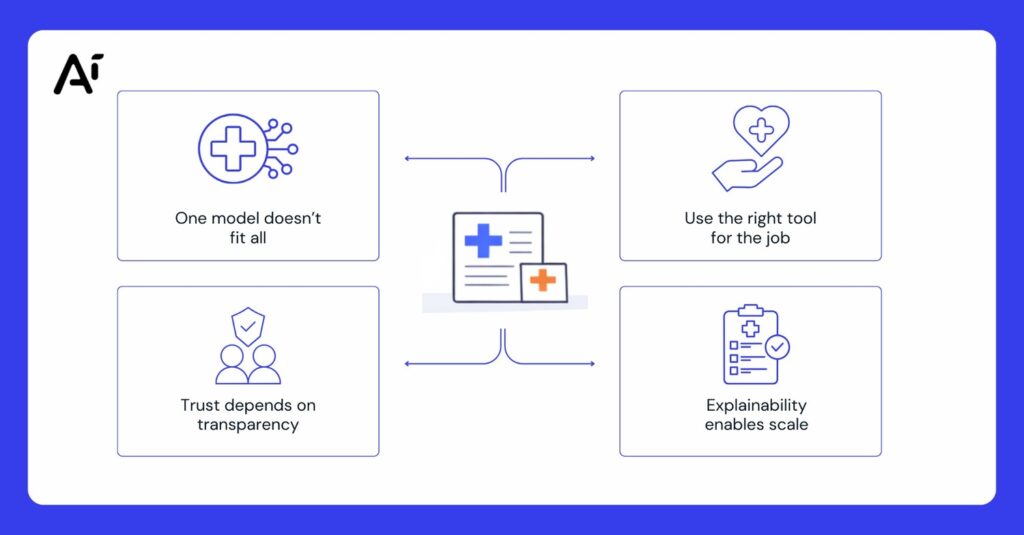
Not every AI model fits every healthcare problem. Selecting the right approach is a key part of the AI development process.
Standard AI technologies used in healthcare include:
The focus should be on reliability and explainability. Healthcare professionals need to trust AI outputs, especially in clinical settings. Transparent models that provide reasoning behind predictions are more likely to be adopted and scaled.
AI solutions should enhance existing workflows, not disrupt them. Integration with electronic health records, hospital management systems, and telemedicine platforms is essential.
Effective AI implementation in healthcare strategies ensures:
Healthcare automation tools work best when they operate quietly in the background, supporting staff without adding complexity. Smooth integration increases adoption and supports scalability across departments.
Scalability is not just about handling more data. It is about designing systems that can evolve with organizational needs.
Key scalability considerations include:
Cloud environments enable healthcare organizations to scale AI workloads in response to demand. Modular architectures make it easier to introduce new AI capabilities without disrupting existing services.
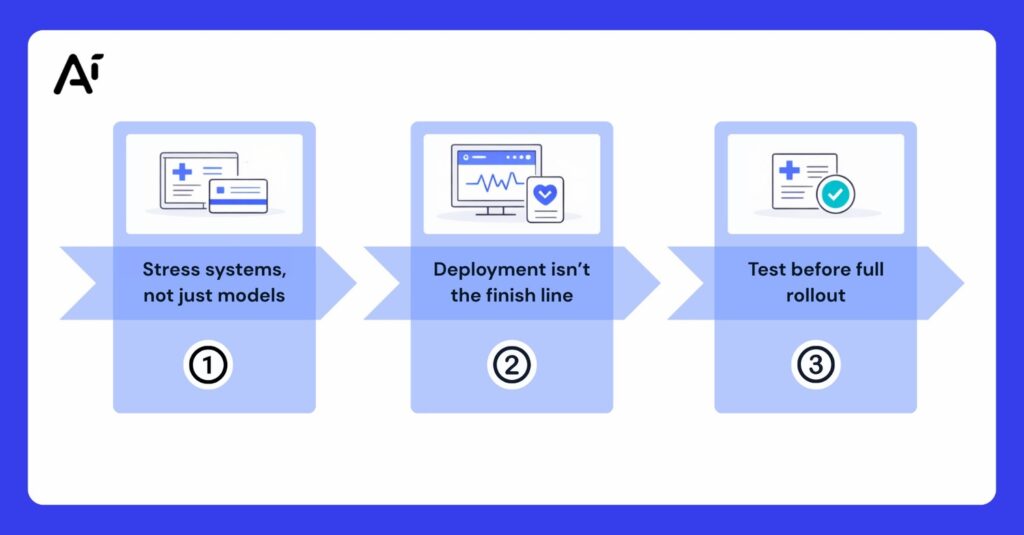
Before full deployment, AI systems must undergo rigorous testing. In healthcare, errors can have serious consequences.
Testing should cover:
Once deployed, continuous monitoring is essential. AI models can degrade over time due to changes in data patterns. Regular validation and updates ensure that systems remain effective as they scale.
Technology alone does not guarantee success. Healthcare professionals need to understand how AI supports their work.
Training programs should focus on:
When staff trust and understand AI systems, adoption increases. High adoption rates are critical for scaling AI across large healthcare organizations.
The final step in implementing AI in medicine and healthcare is ongoing optimization. Organizations should track key performance indicators tied to the original goals.
These may include:
Continuous improvement ensures that AI investments deliver long-term value. As healthcare needs evolve, AI systems should adapt without requiring complete redesigns.
Innovation is not just about adopting new tools. It is about creating systems that can adapt to evolving healthcare needs.
Scalable AI solutions enable healthcare organizations to:
By focusing on scalability and security, healthcare leaders can turn AI into a long-term strategic asset rather than a short-term experiment.
Implementing AI solutions in healthcare requires careful planning, strong technical foundations, and a deep understanding of clinical realities. When done right, AI in medicine and healthcare can transform operations, enhance patient care, and support sustainable growth.
A structured AI development process, combined with secure infrastructure and thoughtful integration, allows healthcare organizations to scale confidently. As demand for digital healthcare continues to rise, scalable AI systems will play a central role in shaping the future of healthcare delivery.
For healthcare organizations looking to innovate responsibly, now is the time to invest in AI systems that are built not just for today, but for the future.