
The healthcare industry is under immense pressure to innovate while maintaining trust. Providers are expected to deliver faster diagnoses, better patient outcomes, and personalized care, all while protecting sensitive patient data and meeting strict regulatory standards. This is where generative AI in healthcare is creating real impact. But building AI solutions for healthcare is not just about innovation. It is about compliance, security, and long-term reliability.
Healthcare organizations today are no longer asking whether AI should be adopted; they are asking how. They are asking how to build AI systems that are safe, compliant, and tailored to real clinical workflows. Partnering with the right development team becomes critical at this stage. AI Panthers works closely with healthcare organizations to design and develop custom AI healthcare software that balances performance, compliance, and trust from day one.
This blog explores why compliance matters in healthcare AI, the risks of generic solutions, and how partnering with experienced teams helps organizations build secure, scalable, and regulation-ready AI applications.
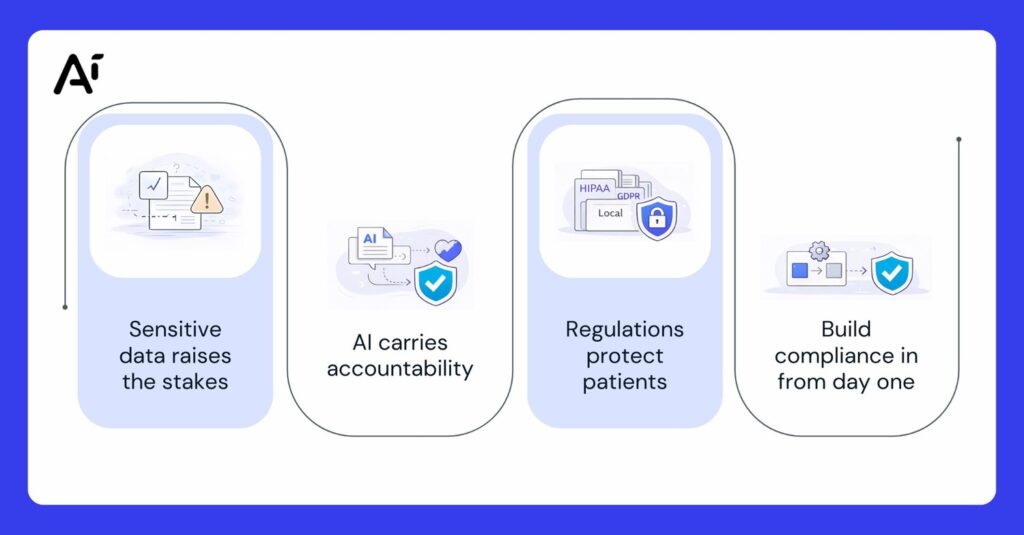
Healthcare data is among the most sensitive data in the world. Patient records include personal details, medical history, diagnostics, and financial information. Any misuse, breach, or misinterpretation can have serious legal and ethical consequences.
When organizations adopt generative AI in healthcare, they are not only dealing with data security but also with accountability. AI models influence clinical decisions, automate documentation, and interact directly with patients. If these systems are not built responsibly, the risk extends beyond fines and penalties. It can damage patient trust and institutional credibility.
Regulations such as HIPAA, GDPR, and local healthcare data protection laws exist to ensure patient safety and data integrity. Building HIPAA-compliant AI apps is not optional for healthcare organizations operating in regulated markets. Compliance must be embedded into the architecture, workflows, and data pipelines of AI systems, not added later as a patch.
Many healthcare providers turn to prebuilt AI tools because they promise faster deployment. While these tools may offer short-term convenience, they often create long-term challenges.
Generic AI platforms are built to serve multiple industries at once. As a result, they rarely align with the specific compliance, security, and operational needs of healthcare organizations. Common issues include limited control over data storage, unclear sources for model training, and restricted customization of clinical workflows.
Off-the-shelf tools also struggle with scalability. As healthcare organizations grow, they need AI systems that adapt to new data sources, evolving regulations, and changing patient needs. This is where custom AI healthcare software provides a clear advantage.
By developing AI solutions from the ground up, organizations gain complete control over data handling, compliance frameworks, and system performance.
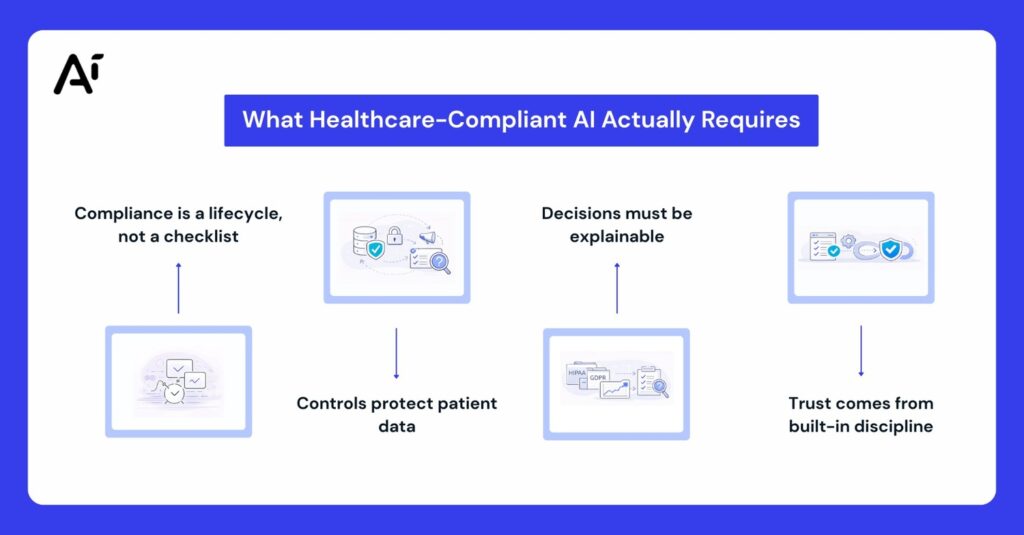
Compliance in healthcare AI is not limited to a checklist. It is a continuous process that spans design, development, deployment, and maintenance.
A compliant AI healthcare application typically includes secure data pipelines, strict access controls, encryption at rest and in transit, and clear audit trails. Patient data must be anonymized or de-identified where required, and model training processes must be transparent and traceable.
Another critical aspect is explainability. Generative AI in healthcare must be able to justify its outputs, especially in clinical decision support systems. Doctors and administrators need to understand how an AI model arrived at a recommendation, not just the result itself.
AI Panthers designs AI systems with compliance embedded into every layer. From secure architecture planning to deployment audits, the focus remains on long-term trust rather than short-term speed.
Healthcare organizations operate in complex environments. Workflows vary between hospitals, clinics, insurers, and digital health platforms. A one-size-fits-all AI solution cannot address these differences effectively.
Custom AI development enables organizations to build systems that align with their specific goals, whether automating medical documentation, improving diagnostics, or enhancing patient engagement. It also allows teams to integrate AI directly into existing electronic health records, telemedicine platforms, and internal dashboards.
When working with experienced healthcare AI vendors, organizations benefit from domain expertise that goes beyond model building. Understanding clinical workflows, compliance requirements, and user adoption challenges is just as important as technical capability.
Generative AI is already transforming multiple areas of healthcare when implemented responsibly.
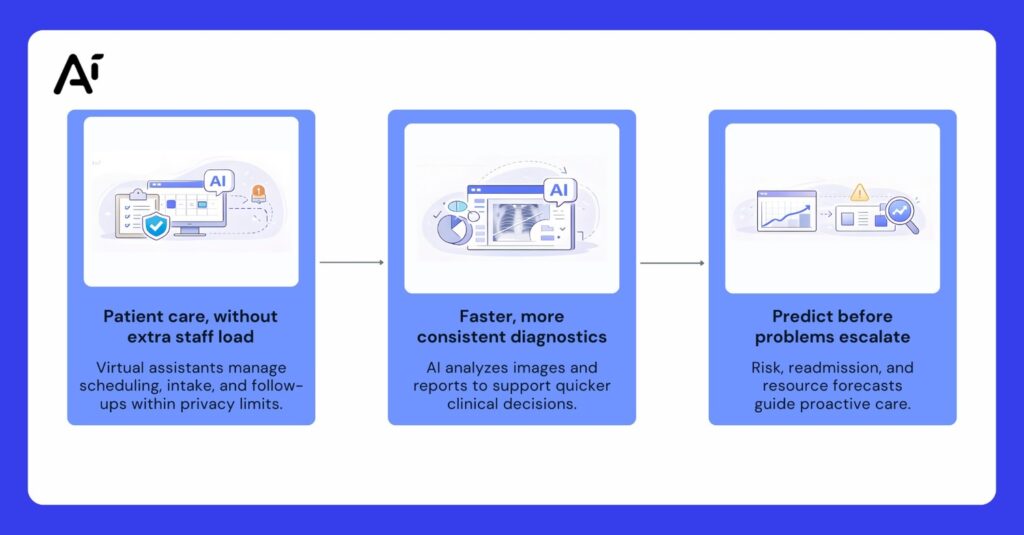
In patient care, AI-powered virtual assistants handle appointment scheduling, symptom intake, and follow-up reminders while maintaining compliance with patient privacy regulations.
In diagnostics, AI models analyze imaging data and medical reports to provide clinicians with faster, more accurate insights. These systems reduce manual workload while improving analysis consistency.
Administrative automation is another high-impact area. Generative AI can process clinical notes, summarize patient interactions, and streamline documentation workflows. This reduces burnout among healthcare professionals and improves operational efficiency.
Predictive analytics powered by AI helps organizations anticipate patient risks, hospital readmissions, and resource needs. When built with secure data practices, these systems deliver actionable insights without compromising privacy.
Security is the foundation of trust in healthcare AI. Without robust security measures, even the most advanced AI model becomes a liability.
AI Panthers follows a security-first approach when building healthcare AI solutions. This includes role-based access controls, secure authentication mechanisms, encrypted data storage, and continuous vulnerability monitoring.
Model security is also critical. Generative AI systems must be protected against data leakage, prompt injection, and unauthorized access. Secure deployment practices ensure that AI models operate within defined boundaries and comply with regulatory standards.
By prioritizing security at the architectural level, organizations avoid costly rework and future compliance risks.
Building compliant AI solutions requires more than technical expertise. It requires partnership, transparency, and long-term commitment.
AI Panthers works as an extension of your internal team. The focus is not just on delivering an AI application, but on understanding your compliance requirements, operational challenges, and growth plans.
Unlike generic healthcare AI vendors, AI Panthers specializes in custom AI healthcare software tailored to real-world use cases. From early discovery workshops to post-deployment optimization, every phase is designed to ensure reliability and compliance.
The team brings deep experience in healthcare app development combined with AI-first thinking. This allows organizations to innovate confidently without compromising on trust.
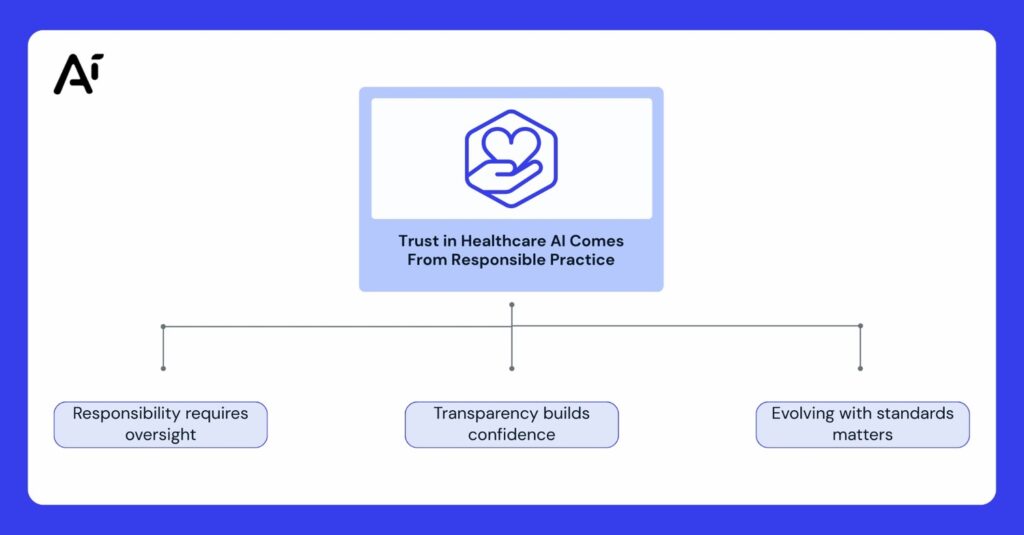
Trust is earned through consistency and accountability. In healthcare, this means building AI systems that respect patient rights, support clinicians, and comply with regulations across regions.
Responsible AI practices include bias monitoring, model validation, continuous performance evaluation, and transparent communication with stakeholders. Generative AI in healthcare must evolve alongside medical standards and regulatory frameworks.
AI Panthers adopts responsible AI principles as part of its development philosophy. This ensures that AI solutions remain effective, ethical, and compliant as they scale.
The future of healthcare AI will be shaped by organizations that prioritize trust alongside innovation. As adoption increases, regulators will continue to tighten standards around data usage, transparency, and accountability.
Healthcare organizations that invest in compliant, custom-built AI systems today will be better positioned to adapt to future regulations and technological shifts. Generative AI in healthcare will continue to expand into areas such as personalized medicine, population health management, and clinical research.
Partnering with the right development team ensures that innovation does not come at the cost of compliance.
Generative AI in healthcare has the potential to transform patient care, improve efficiency, and reduce operational strain. But success depends on how these systems are built and who you build them with.
By choosing custom development over generic solutions, healthcare organizations gain control, compliance, and confidence. AI Panthers helps organizations navigate this journey with a focus on security, transparency, and long-term value.
If your goal is to build secure, compliant, and scalable AI healthcare solutions, partnering with AI Panthers is a strategic step toward responsible innovation.