
Healthcare organizations today are under increasing pressure to modernize, automate, and deliver faster patient outcomes. Yet every innovation must meet the highest standards of security, compliance, and trust. This is precisely where the right technology partner makes all the difference.
This is the problem AI Panthers focuses on solving.
With the growing demand for AI solutions in healthcare, supported by substantial search volumes and market readiness, clinical NLP automation is becoming one of the most impactful investments for modern healthcare organisations. Smarter documentation is no longer a “nice to have”. It directly improves accuracy and patient outcomes, reduces administrative load, and finally allows clinicians to focus on care rather than paperwork.
In this blog, we explore how AI medical documentation technology is reshaping the healthcare system, why clinical NLP is becoming a core part of EHR workflows, and what role AI scribe tools can play in improving efficiency at scale.
Healthcare documentation is complex by nature. Every detail matters. A missed symptom, a wrong dosage, or an incomplete history note can influence clinical decisions. But doing it perfectly, consistently, and quickly is difficult in a busy care environment.
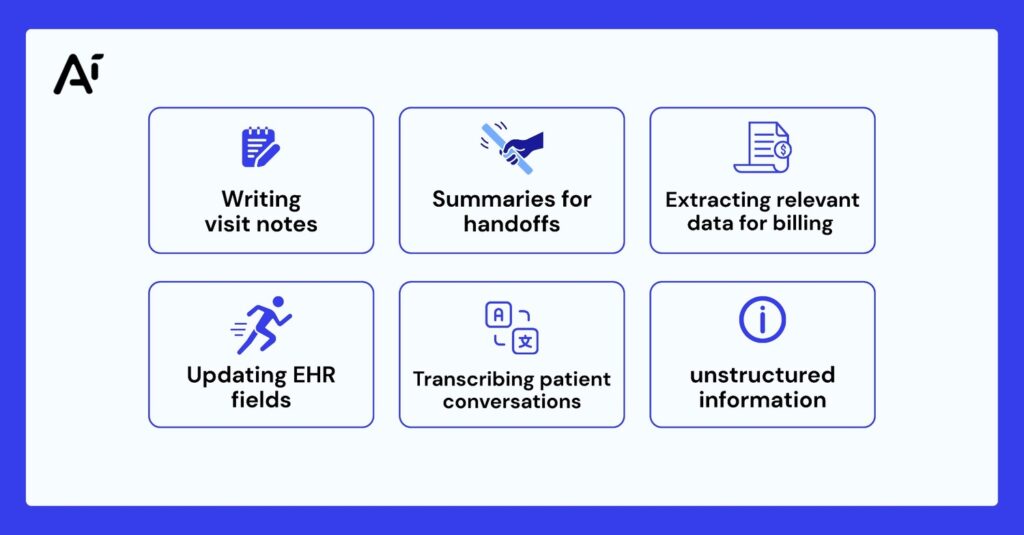
Doctors face several repetitive tasks:
Even small inefficiencies add up. Hospitals lose thousands of productive hours every year simply because documentation takes too long. This is where clinical NLP automation introduces a decisive shift. Instead of manual data entry, AI converts conversations into structured medical insights that fit directly into existing workflows.
Traditional transcription tools merely convert speech into text. Modern EHR transcription AI goes much further. It combines Natural Language Processing, medical terminology recognition, and context-aware models to generate meaningful clinical notes.
The new generation of AI documentation systems performs tasks like:
Instead of typing notes after every appointment, doctors review and verify suggestions prepared by AI. It reduces cognitive load and eliminates errors that often creep in due to fatigue or delays.
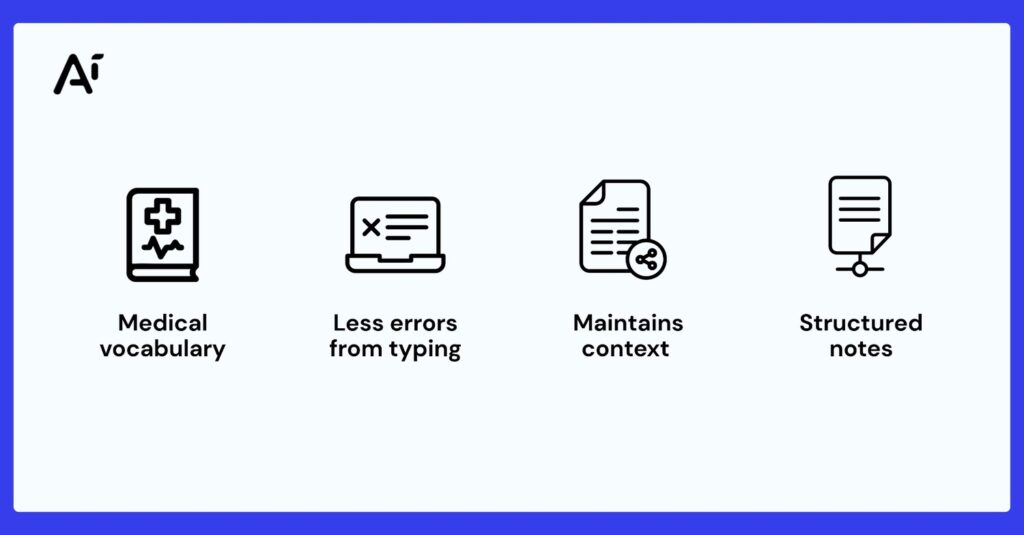
Accuracy is the core priority for AI Panthers. Healthcare organisations cannot afford guesswork or incomplete documentation. Clinical NLP automation improves precision in the following ways:
Unlike general-purpose speech recognition systems, AI medical documentation systems are trained on authentic clinical conversations. They understand drug names, anatomical terms, disease patterns, and abbreviations.
Every minute spent typing is a minute where distractions can happen. NLP-driven automation ensures consistent formatting and correct spellings.
AI scribe tools track the flow of the interaction. If a patient described chest discomfort earlier and mentions “it” again later, the AI knows what “it” refers to.
Structured data improves the quality of care by making it easier to review patient history, compare changes, and identify risks.
The result is simple. Higher accuracy leads to better patient outcomes. Doctors gain time and clarity while patients receive care without delays.
AI scribe tools have quickly become among the most widely adopted AI solutions in hospitals and clinics. They combine convenience with reliability and integrate smoothly with telehealth or in-person consultations.
Key benefits include:
When doctors no longer juggle conversations with typing, they listen more actively and respond more meaningfully. This improves patient satisfaction and diagnostic quality simultaneously.
NLP for healthcare does not just capture words. It understands the intention and medical relevance behind them.
For example, if a patient says, “I have been having trouble breathing when climbing stairs”, the AI identifies:
Similarly, when the doctor recommends a plan, the system automatically categorises it under “assessment” and “plan”.
The ability to convert raw speech into actionable medical insights is what makes clinical NLP automation so transformative.
Electronic Health Records have become the backbone of modern healthcare, but they are often a source of administrative burden. EHR transcription AI simplifies this by creating ready-to-upload content.
AI Panthers builds systems that plug into existing EHRs, so staff do not need to change platforms or adopt new tools. This reduces friction and speeds up adoption.
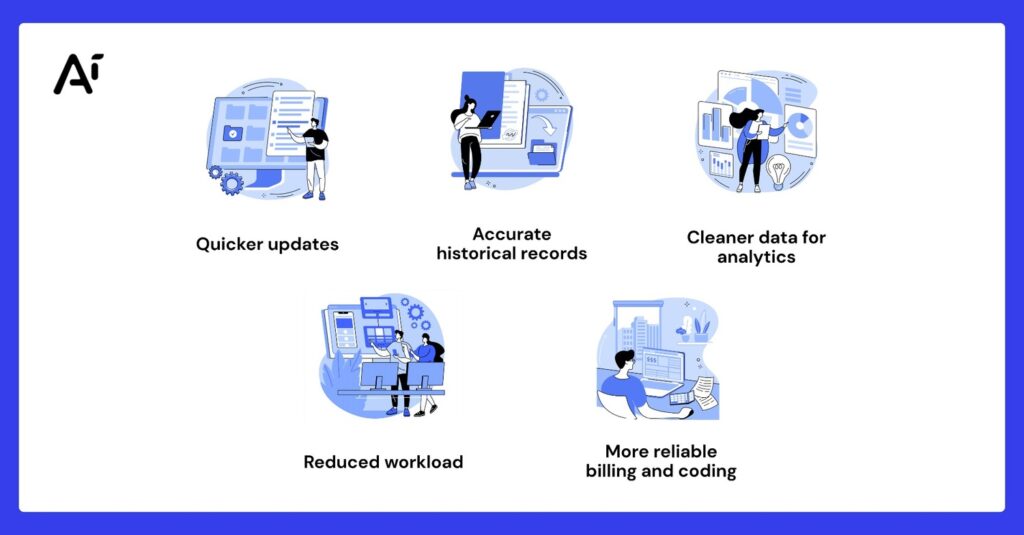
What healthcare teams gain:
With cleaner datasets, hospitals can even power advanced analytics and forecasting tools, helping them identify risks earlier.
Among all industries adopting AI, healthcare shows the strongest growth and highest demand, especially for documentation and record automation. Search data clearly reflects this trend. Healthcare has the most significant volume of AI-related searches and one of the strongest needs for AI-powered solutions.
This momentum is driven by:
Clinical NLP automation directly supports these needs and offers measurable outcomes in efficiency and quality.
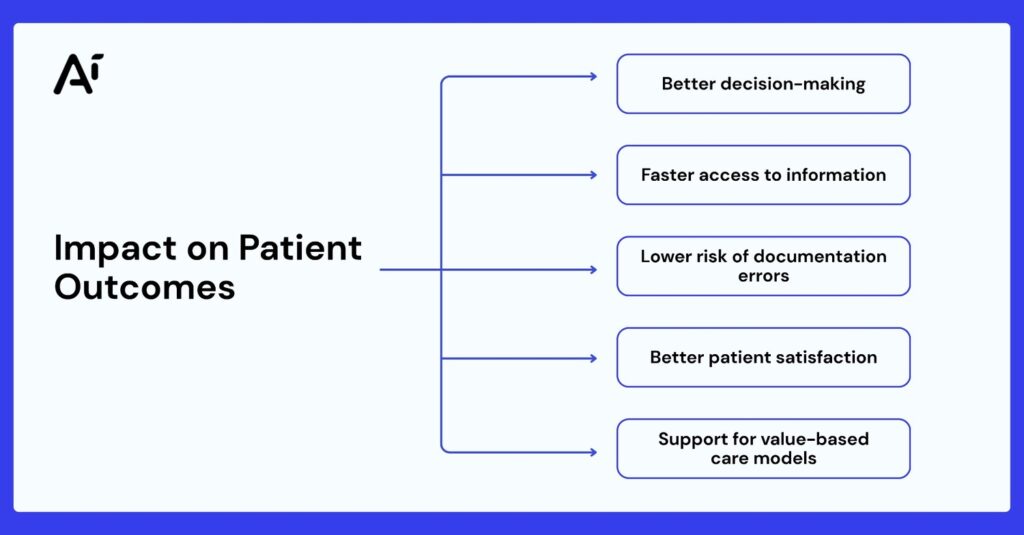
Smarter documentation does more than save time. It creates a ripple effect across the entire care journey.
Accurate notes help doctors revisit details with clarity, improving diagnostics and reducing follow-up gaps.
Digital summaries allow teams to coordinate treatments without delays.
AI medical documentation reduces inconsistencies that can lead to miscommunication or wrong prescriptions.
Doctors spend more time interacting with patients and less time typing.
Clean data enables hospitals to demonstrate quality, outcomes, and compliance more effectively.
With the right implementation partner, the impact is immediate and scalable.
AI Panthers delivers custom clinical NLP automation tailored to each organisation’s workflows. Grounded in a strong understanding of healthcare AI demand and user behaviour, the company helps healthcare clients adopt reliable, secure, and compliant NLP systems that drive tangible outcomes.
Our approach includes:
Healthcare organisations gain not just an automated scribe, but a long-term AI partner capable of scaling across departments and use cases.
Medical documentation cannot rely solely on manual processes. It is slow, error-prone, and burdensome for clinicians. AI-powered medical documentation, powered by advanced NLP, offers a timely, realistic solution that improves accuracy and patient outcomes.
AI scribe tools and clinical NLP automation are transforming how hospitals operate and how doctors engage with patients. They unlock time, improve clarity, and give healthcare teams the confidence of working with cleaner, more reliable data.
The result is a healthcare system that runs smarter, faster, and with a deeper focus on patient well-being.