
Healthcare is at a critical turning point. Hospitals, clinics, and digital health companies are under pressure to deliver better patient outcomes while managing rising costs, staff shortages, and growing volumes of data. In this environment, generative AI in healthcare is no longer a futuristic concept. It is becoming a practical foundation for improving accuracy, efficiency, and consistency across healthcare delivery.
From clinical decision support to patient engagement and operational automation, generative AI is reshaping how care is planned, delivered, and monitored. When implemented correctly through well-designed AI applications, it helps healthcare organizations reduce errors, speed up workflows, and improve outcomes without compromising trust or compliance.
This blog explores how generative AI works in healthcare, where it creates the most impact today, and why it is central to the future of healthcare AI.
Generative AI refers to models that can create new content, insights, or predictions based on large volumes of data. In healthcare, this includes generating clinical summaries, assisting with diagnosis, predicting patient risks, and supporting personalized treatment plans.
Unlike rule-based systems, generative AI learns from patterns in medical records, imaging data, lab results, and real-world outcomes. This allows healthcare systems to move from reactive care to proactive and data-driven decision-making.
For healthcare providers, the real value lies in accuracy. Medical decisions are complex, and even minor errors can impact patient outcomes. Generative AI helps reduce variability by supporting clinicians with consistent, evidence-based insights at the point of care.
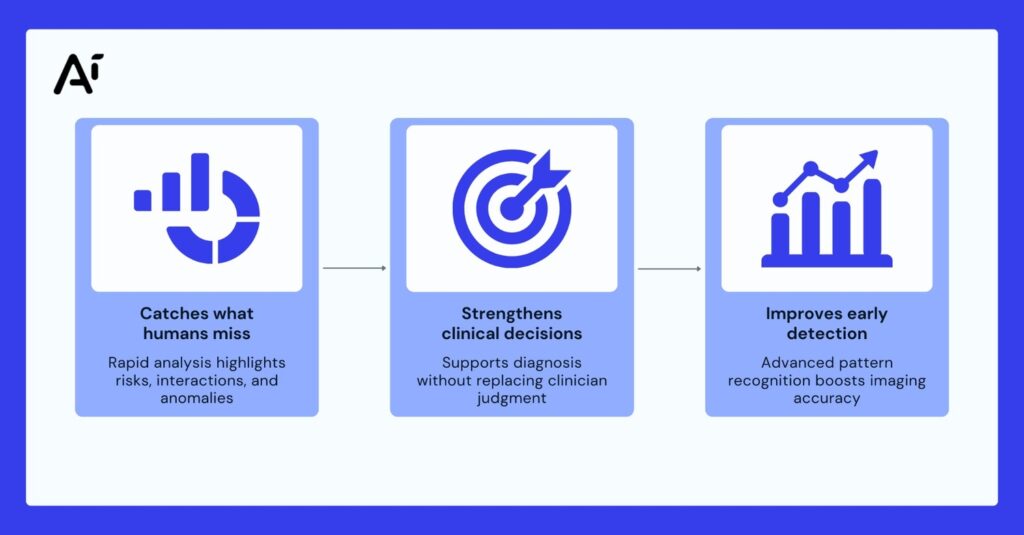
Doctors process enormous amounts of information every day. Generative AI systems analyze patient histories, symptoms, and diagnostic data in seconds, surfacing relevant insights that might otherwise be missed.
For example, AI models can flag potential drug interactions, highlight abnormal test results, or suggest differential diagnoses based on similar historical cases. This does not replace clinicians. It supports them with an additional layer of accuracy and confidence.
In areas like radiology and pathology, AI-driven analysis has shown significant improvements in detection accuracy. Generative AI models trained on thousands of scans can identify subtle patterns that are difficult to spot with the human eye alone.
Solutions inspired by platforms such as Zebra Medical Vision and research initiatives like Google DeepMind have demonstrated how AI can assist in early disease detection, especially for conditions where timing is critical.
When integrated into clinical workflows, these tools help reduce misdiagnosis and speed up treatment decisions.
Accuracy alone is not enough. Healthcare systems must also operate efficiently to serve more patients without burnout or delays. This is where generative AI delivers measurable operational benefits.
Administrative work consumes a significant portion of a clinician’s day. Generative AI can automatically convert doctor-patient conversations into structured medical notes, discharge summaries, and referral letters.
Tools inspired by platforms like Nuance demonstrate how AI-driven documentation reduces manual data entry while improving record accuracy. This allows clinicians to focus more time on patient care rather than paperwork.
AI-powered virtual assistants handle appointment scheduling, symptom intake, follow-ups, and basic patient queries. These systems provide consistent responses and operate around the clock.
Healthcare apps influenced by solutions such as Ada Health and Babylon Health show how AI can guide patients toward the right level of care while reducing unnecessary hospital visits.
For hospitals, this improves efficiency. For patients, it creates faster access and better experiences.
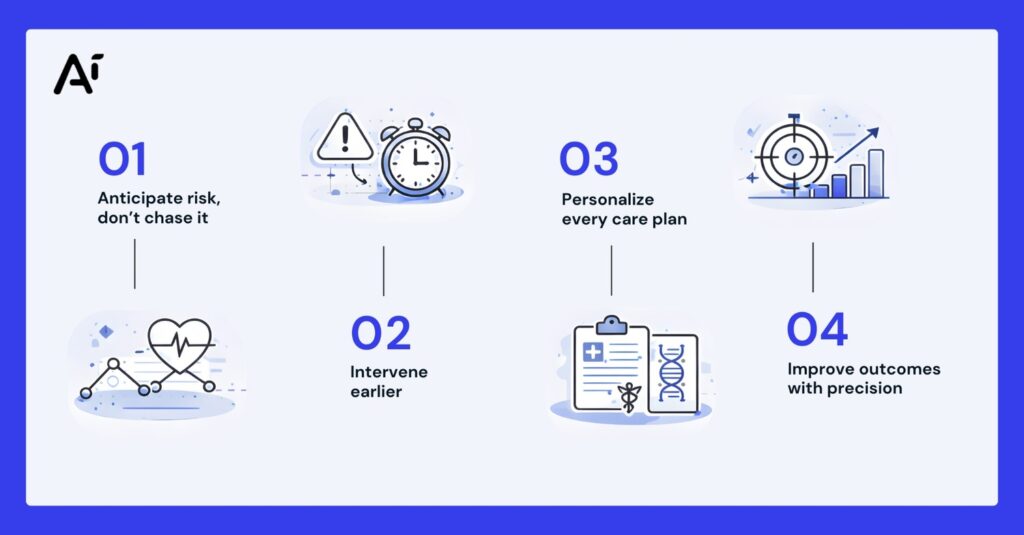
One of the most potent benefits of generative AI in healthcare is predictive analytics. Instead of reacting to health events, providers can anticipate them.
AI models analyze historical data to identify patients at higher risk of complications, readmissions, or disease progression. Hospitals can intervene earlier, adjust treatment plans, and allocate resources more effectively.
Institutions such as the Cleveland Clinic have explored predictive analytics to support critical care decision-making, particularly in intensive care settings where timing is crucial.
Generative AI enables more personalized treatment planning by combining genetic data, lifestyle information, and clinical history. This approach improves outcomes by tailoring therapies to individual patients rather than relying on one-size-fits-all protocols.
Companies like Tempus illustrate how AI-driven insights can guide oncology treatments and medication selection with higher precision.
Several AI healthcare trends are accelerating adoption across the industry.
First, telemedicine platforms are integrating AI symptom checkers and triage tools to support remote consultations. Solutions similar to Teladoc and HealthTap demonstrate how AI enhances virtual care by improving diagnostic accuracy and continuity.
Second, wearable devices and IoT sensors are feeding real-time data into AI systems. Generative AI models analyze this data to detect anomalies and alert care teams before conditions worsen.
Third, healthcare organizations are increasingly investing in custom AI applications rather than off-the-shelf tools. This allows tighter integration with existing systems, better compliance control, and alignment with specific clinical workflows.
The benefits of AI in hospitals go beyond technology. They directly impact patient safety, clinician satisfaction, and financial sustainability.
Hospitals using AI-driven applications report fewer documentation errors, faster turnaround times for diagnostics, and better coordination between departments. Predictive insights help reduce emergency admissions and avoidable readmissions.
From a patient perspective, AI improves access to care, reduces waiting times, and supports more transparent communication. From an organizational standpoint, it helps manage costs while maintaining quality.
Generative AI delivers value only when built and deployed responsibly. Healthcare AI applications must be accurate, secure, and compliant with data protection regulations.
This is where experienced AI app development partners play a critical role. Successful projects focus on clean data pipelines, model validation, explainability, and integration with clinical workflows.
Rather than experimenting with generic tools, healthcare organizations benefit from custom AI applications designed around their specific care models, patient populations, and operational goals.
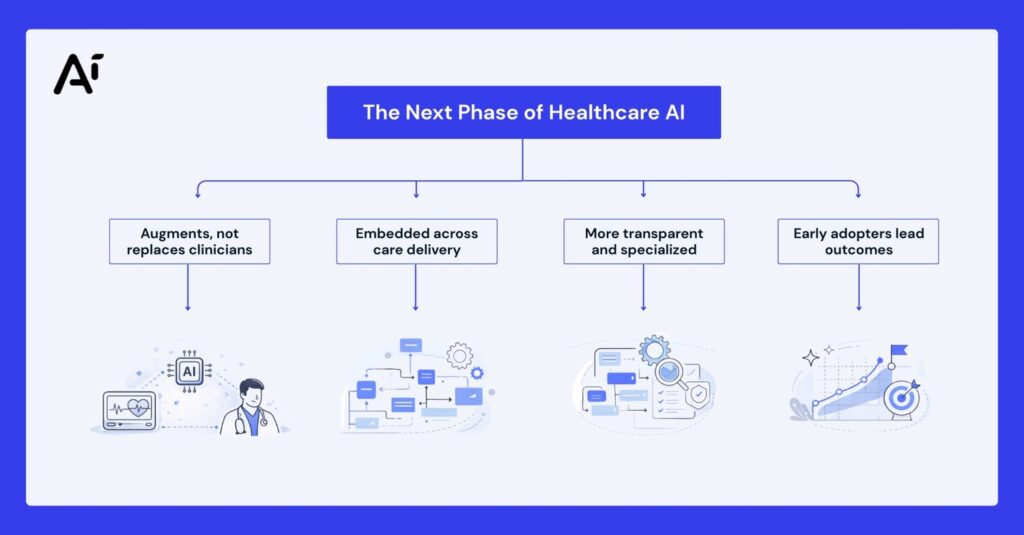
The future of healthcare AI is not about replacing clinicians. It is about augmenting human expertise with reliable, data-driven intelligence.
As generative AI in healthcare continues to evolve, we will see deeper integration across diagnostics, treatment planning, population health management, and patient engagement. AI systems will become more transparent, more specialized, and more aligned with clinical best practices.
Healthcare organizations that invest early in AI app development will be better positioned to deliver safer, faster, and more personalized care in the years ahead.
Generative AI in healthcare is already transforming how care is delivered. By improving accuracy, automating complex workflows, and enabling predictive insights, it directly supports better patient outcomes and operational efficiency.
For hospitals, digital health startups, and healthcare providers, the question is no longer whether to adopt AI. It is how to implement it responsibly, securely, and in a way that delivers real clinical value.
When built with the right strategy and expertise, generative AI becomes a powerful ally in shaping the future of healthcare.