
Healthcare organizations worldwide are facing a similar situation. Clinical demand is rising, administrative workloads continue to expand, and digital-first services now shape patient expectations. In this environment, leaders are looking for solutions that deliver both operational efficiency and long-term resilience. This is precisely where AI in healthcare can have the most significant impact.
AI adoption in the sector is no longer a futuristic concept. It has already gained meaningful traction, especially in areas such as imaging, record automation, telemedicine, and predictive analytics. Search behaviour also reflects this shift, with healthcare showing the highest volume of AI-related keywords among industries. The combined demand for AI and healthcare app development makes the sector an ideal ground for innovation and scalability.
But awareness alone does not guarantee successful implementation. Many healthcare organizations struggle with fragmented systems, inconsistent data, and uncertainty around Compliance and scale. To address these gaps, the adoption process needs a structured and practical approach.
Below is a step-by-step framework for healthcare leaders to design, implement, and scale AI systems with confidence.
Most successful AI implementations begin with a clear understanding of where automation or predictive intelligence can shift outcomes. Healthcare leaders typically look at high-friction processes first.
Common areas where AI drives immediate value include:
These use cases stand out for a simple reason. They improve both care delivery and operational efficiency, two areas that directly influence patient outcomes and system sustainability. Organizations that start small, with one or two high-impact areas, often scale more successfully because they gain early internal alignment and trust.
AI implementation in healthcare programs often slows down or fails because the data environment is not ready for intelligent systems. Healthcare data is rich but fragmented, unstructured, and subject to strict compliance requirements.
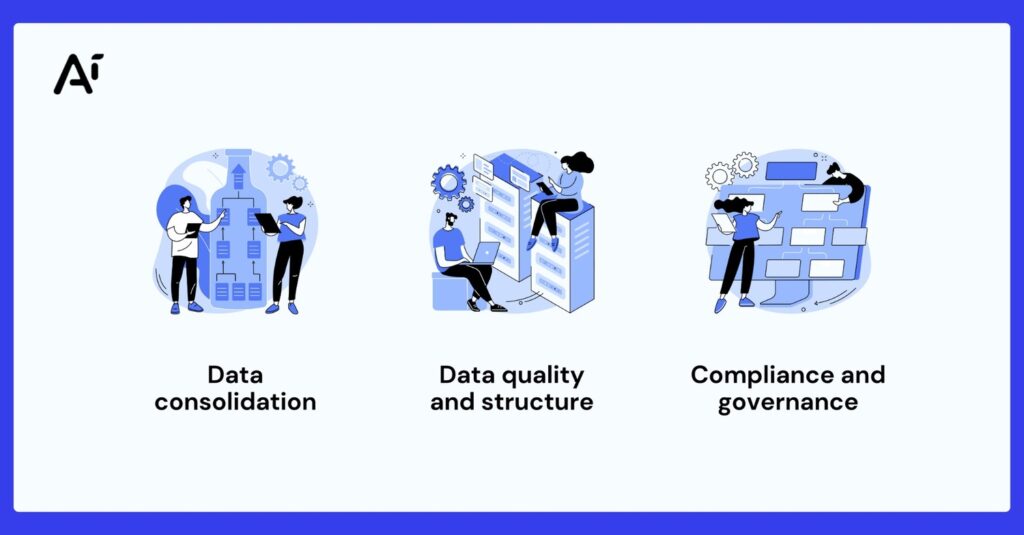
To build a scalable AI foundation, organizations should focus on three essentials:
a. Data consolidation
Bringing together records from EHRs, imaging systems, laboratory databases, telemedicine tools, and billing systems forms the baseline. Without integrated data, AI outputs remain incomplete or biased.
b. Data quality and structure
Cleaning, labeling, and standardizing data are essential steps. Good model performance depends heavily on consistency.
c. Compliance and governance
Any system that touches patient data must comply with HIPAA, HL7 standards, and regional data protection laws. Security controls, access frameworks, and audit environments should be established early, not as afterthoughts.
Organizations that invest in a strong data foundation typically see smoother deployments and fewer interruptions once the AI system goes live.
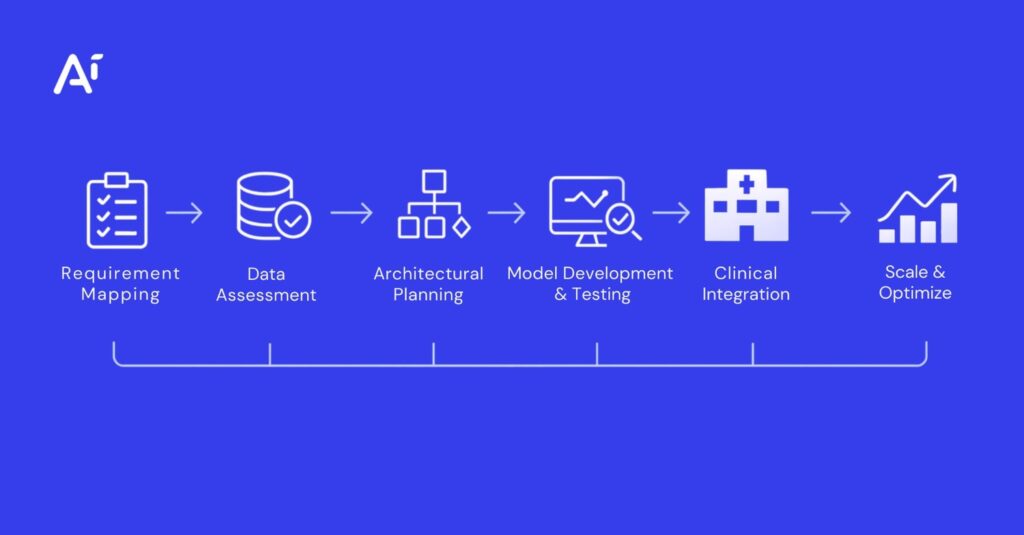
Healthcare organizations often jump directly into development, but a structured AI development process simplifies deployment and ensures better outcomes.
A typical process includes:
This structured workflow is critical in healthcare because patient safety depends on how accurately the system performs under real clinical conditions.
In healthcare, trust is not optional. Patients, clinicians, and administrators depend on systems that are safe, accurate, and compliant. Any AI implementation must be designed with security and ethical usage at the core.
Key priorities include:
AI solutions built with these principles from the start scale more smoothly, especially when organizations undergo compliance reviews or expand into new markets.
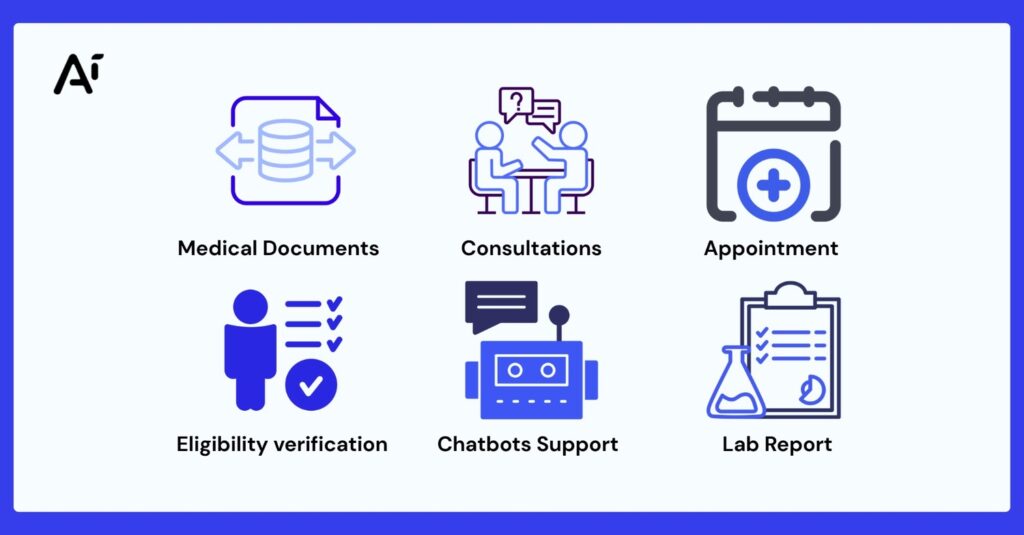
One of the most substantial advantages of AI for healthcare is its ability to reduce repetitive, manual work. When automation is introduced thoughtfully, clinical teams regain time to focus on patient care rather than administrative tasks.
Popular healthcare automation tools include:
Automation becomes even more valuable when integrated into existing workflows rather than added as a separate layer. This reduces friction and increases adoption among clinicians and support staff.
Today’s healthcare ecosystem is increasingly digital. AI works best when it blends into the platforms that patients and providers already use.
This includes:
Demand for healthcare app development continues to grow, with more than 4,600 monthly searches for related keywords. This indicates that providers are actively seeking platforms that embed AI directly into the patient experience.
For example, integrating AI symptom checkers into telemedicine apps can reduce waiting times. Similarly, AI-driven reminders in patient apps can improve medication adherence.
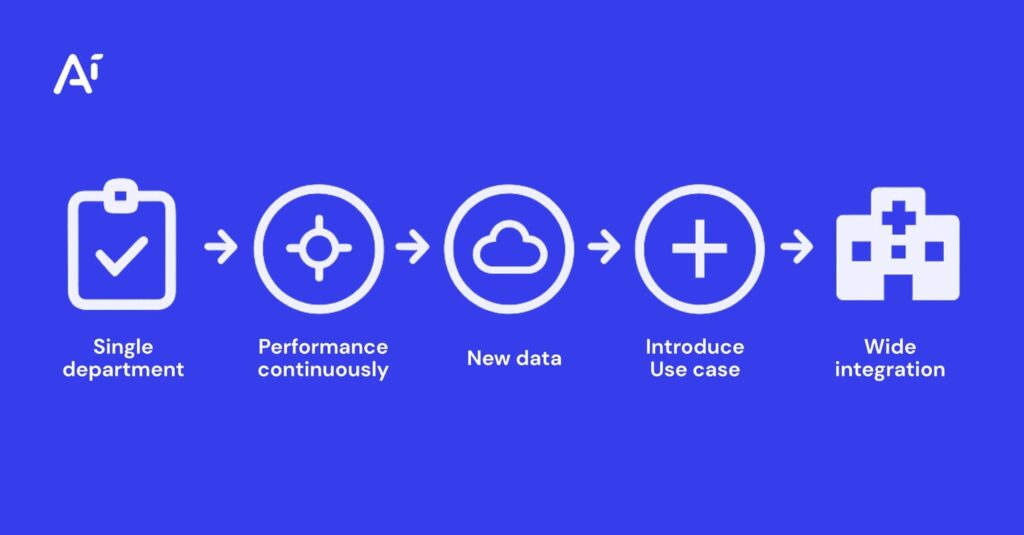
Scaling AI in healthcare requires a careful balance. Systems need to handle more data, more users, and broader workflows without compromising performance.
Organizations should expand gradually using a phased approach:
Scalability becomes easier when AI is built using modular components, cloud architectures, and API-based integrations.
AI projects that succeed in the long term treat model performance, security, and workflow optimization as ongoing responsibilities. Leaders track improvements in specific areas such as:
These metrics help organizations refine the AI system, identify new opportunities, and maintain alignment with strategic goals.
Healthcare is entering a phase where intelligent systems are no longer optional. They are becoming essential to running efficient, accurate, and patient-focused operations. With the healthcare sector showing the strongest search demand for AI solutions and digital health development, the momentum is already here.
Organizations that adopt AI early, and do so with a structured, secure, and scalable approach, place themselves in a stronger position for the future. They reduce operational complexity, improve clinical outcomes, and enable faster innovation.
AI Panthers helps healthcare organizations move from idea to fully operational AI systems through a combination of deep technical expertise, industry understanding, and scalable development practices. For healthcare leaders planning their next phase of digital transformation, this structured approach can serve as a practical roadmap for building a future-ready, AI-powered healthcare ecosystem.